Tuesday, August 28, 2007

Angkor Wat: In Pictures (Part 3)

To close our "Angkor Wat: In Pictures" series, we exit the temple through the weathered Western Entrance.

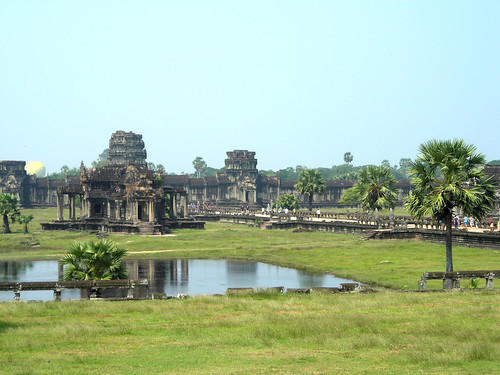
View of the Western Entrance from the temple. Foreground left was the ancient library; walkway leads to the Western gate.
DSCN0493

One of the smaller libraries found just outside the central tower complex.
DSCN0522

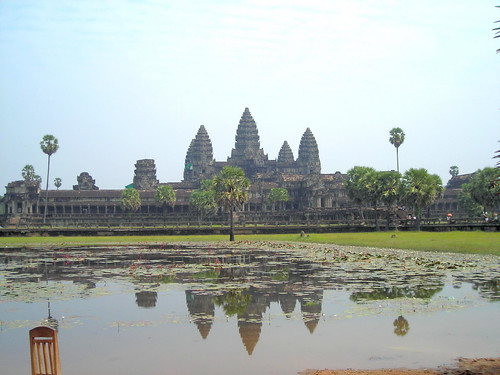
Shot of the temple, directed by our tour guide Mr. Sam.
DSCN0525

DSCN0528

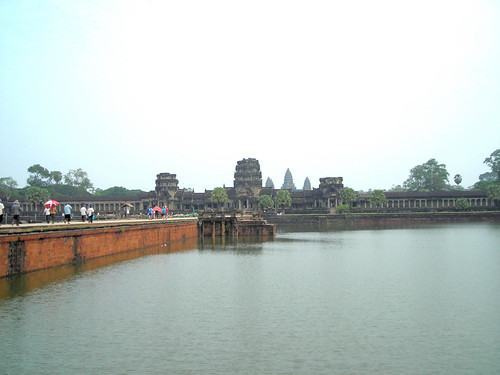
The Western gate, viewed from the other side of the river.
DSCN0534

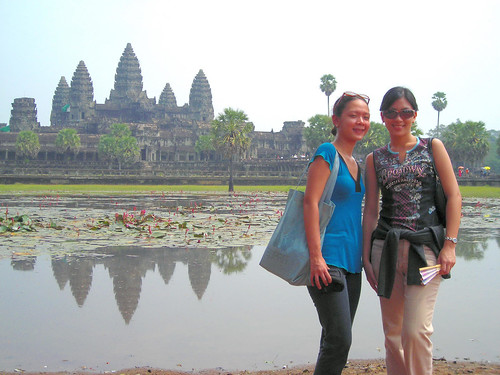
For posterity, of course.
DSCN0527

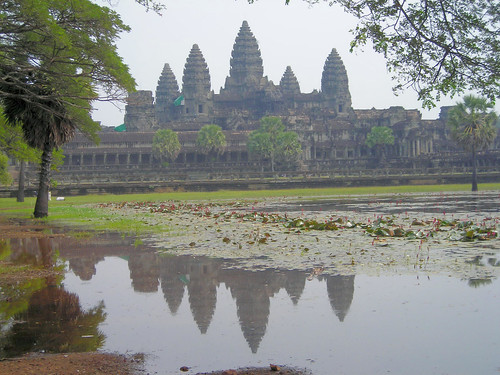
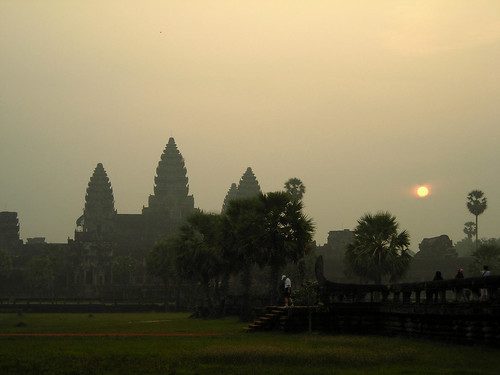
Catching the Angkor Wat during sunrise came highly recommended by friends, acquaintances and guide books, so naturally we got up at 4 am to stake out the sun the next day. (Some photo enthusiasts even had the complete gear, we tell you!) It was a pretty foggy/cloudy morning, so here's our best shot.
DSCN0596

Saturday, July 21, 2007

Angkor Wat: In Pictures (Part 2)

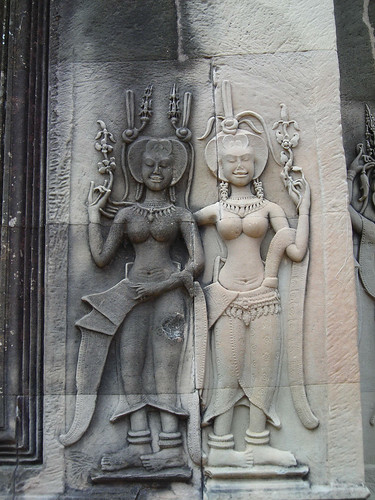
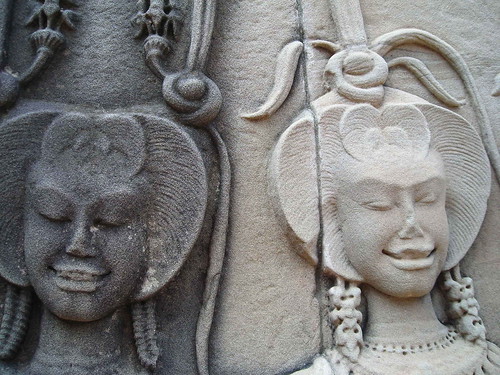
Two special apsaras can be found in Angkor Wat, and they can be found in the central tower complex, facing the three towers. Although hundreds of apsaras grace these same walls, these two are unique.

DSCN0508

And the reason they're special? They actually show teeth in their smile.

DSCN0507

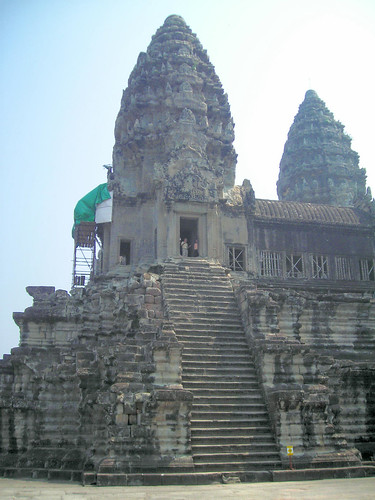
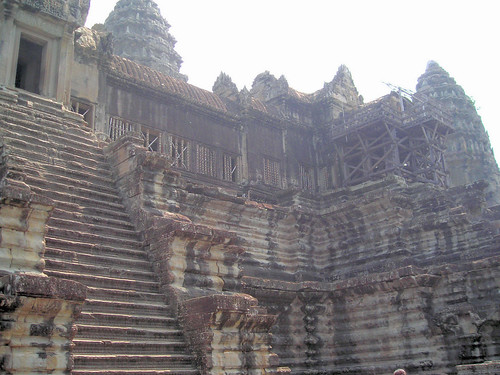
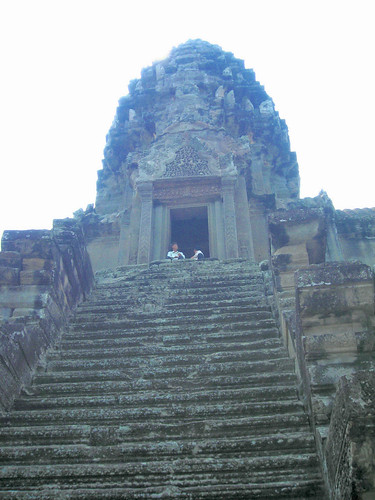
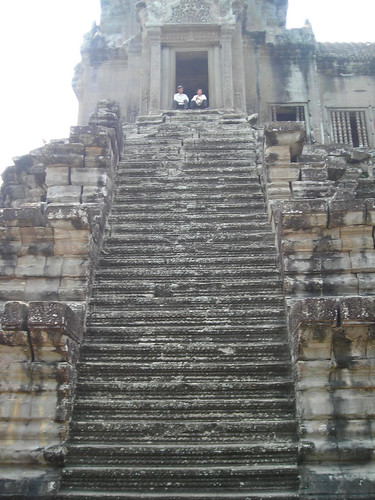
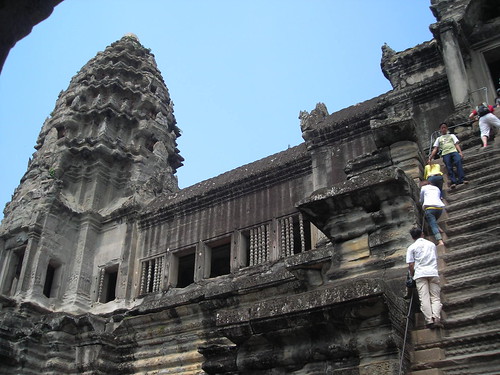
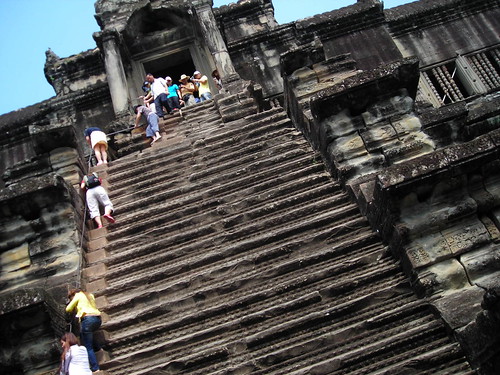
The dizzying height of the steps leading to the three towers. Two of the three towers were under reconstruction/restoration during our visit and thus, were off-limits to tourists.

DSCN0509

DSCN0513

DSCN0515

DSCN0516

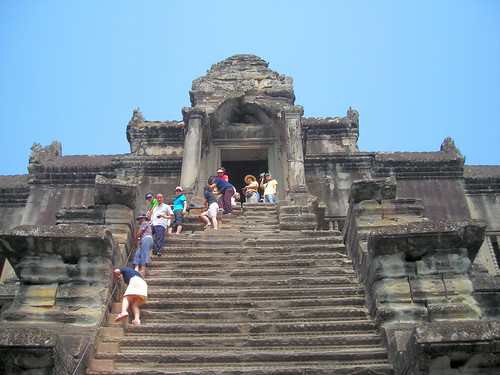
Unfortunately, Nins has acrophobia and prevailed upon Charlie's interest to climb up and go inside the celebrated tower. The sight of tourists cautiously going up and down the steep and eroded steps (from centuries of wear) did little to persuade Nins to make the most out of this trip.

Oh look, an upskirt shot!

DSCN0519

Rails were placed on one the side of the steps so tourists could hold on for dear life while descending or ascending the steps.

DSCN0001

DSCN0002

Up next: pictures from the last leg of the Angkor Wat tour. We then head off to our next temple, Bayon.


Friday, July 20, 2007

Angkor Wat: In Pictures (Part 1)

Enough talk. Here are more photos of Angkor Wat, its carvings and other such things.

Enjoy!

DSCN0476


DSCN0477


DSCN0478

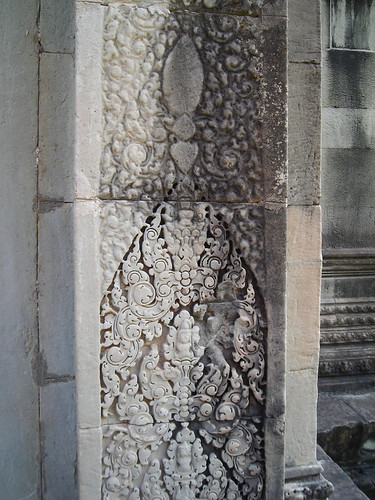
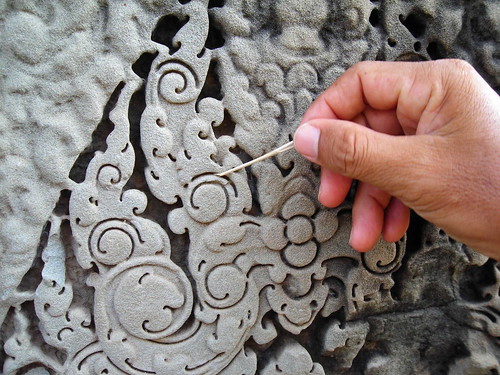
Unfinished carving on one of the pillars. Close-up shows faint lines of the unfinished portion, as against the detail and depth of the finished portion.


DSCN0481

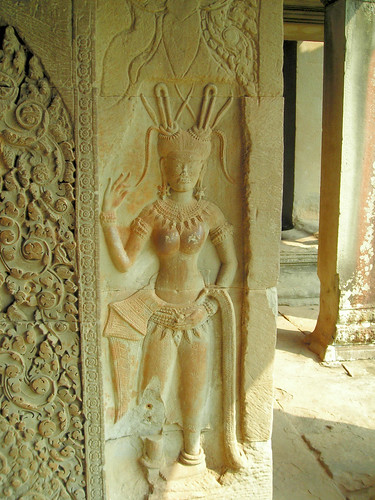
One of the many apsaras in Angkor Wat. (Notice her weathered chest? It could only mean one thing.)


DSCN0496

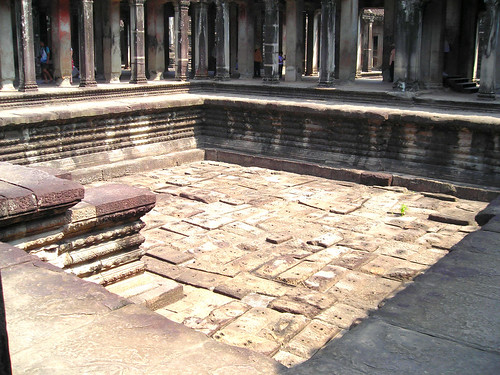
One of four pools where worshipers washed their head and feet before entering the central towers.


DSCN0506

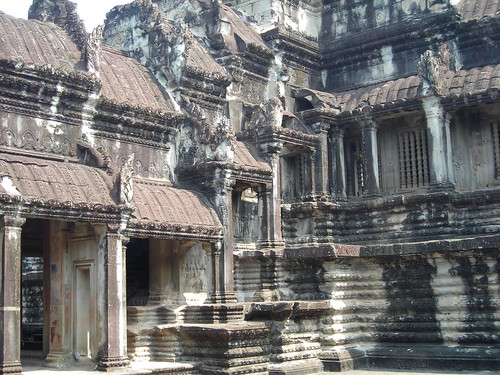
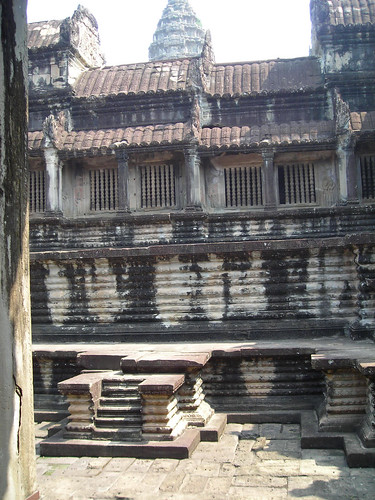
Within these walls surrounding the pool are the eroded and steep steps leading to the central tower complex.


DSCN0505

Eye on the Prize: tower as seen from the pool


DSCN0500

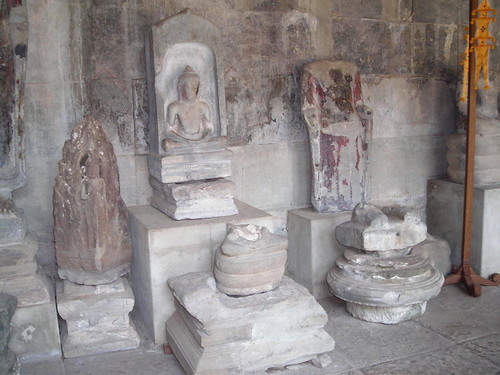
Headless Buddhas stacked around the pool: reminders of a bitter history


DSCN0502

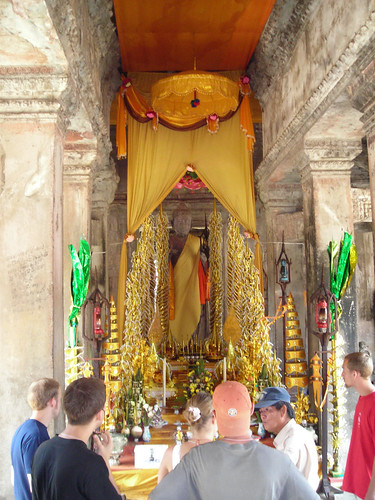
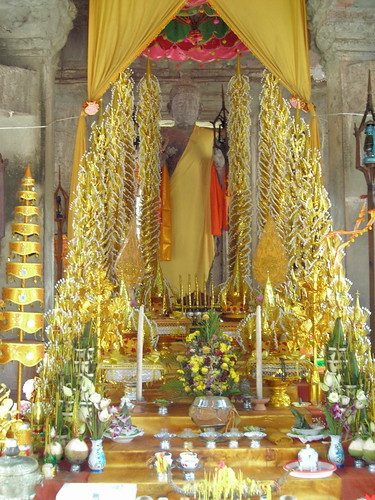
In the walkway dividing the four pools, worshipers continue to adorn this Buddha (and tourist continue to surround it)


DSCN0504

Up close, minus the annoying tourists (including the one taking this picture)

* * *

Up next: Photos from the Central Tower Complex


Saturday, April 14, 2007

Angkor Wat: Stories on the Walls

There is a splendid view of Angkor Wat's Central Towers from the Eastern Entrance. Unlike the view from the Western Entrance where one can immediately see the whole expanse of the temple, the arched doorway of the Eastern Entrance opens directly to a view of the temple's famed towers. It is possible to view the whole expanse from the Eastern front, but the unfinished state of this side of the temple has led to the growth of bushes and trees which now frame the towers and hide both wings of Angkor Wat quite beautifully.

View of the temple towers from the Eastern Entrance

As we walked towards the temple complex the trees' leaves and branches slowly revealed the temple in its entirety, as if it were an establishing shot for a movie. The view from the Eastern side is certainly different from the Western side, as the jolting contrast of a man-made structure quietly overtaken by the natural world was indeed different from the overcrowded, planned and manicured facade that greet tourists at the Western entrance.

The magnificence of Angkor Wat is not only in its architecture, whose magnitude and size are feats all their own given the available resources during its construction. Like most other temples in Siem Reap, the beauty of the temple is in its astounding attention to impeccable detail, with each wall bearing carvings of either intricate delicacy or depicting epic stories. Recalling Mr. Sam's lessons earlier on its construction, we could not imagine just how much work actually went into building this monument of the ancient world.

Still following the same temple pattern/layout as Banteay Srey and Samre, Angkor Wat's outer walls were adorned with bas reliefs depicting the Khmer's legends, epics, and histories. The first story Mr. Sam shared with us was the "Legend of the Churning of the Sea of Milk," which narrates the battle between the gods and demons for immortality. The story sees both gods and demons pulling on both ends of a gigantic snake curled around a mountain, which they did for about a hundred years, to churn the sea of the milk. The first one to taste the milk that came out the sea from this churning would be immortal, and for a time it seemed like the demons would win. Fortunately for the gods' camp they had Vishnu, who had the cunning idea to distract the demons from their impending victory by sending forth beautiful women to dance and entertain them (who we now know as the apsaras). Thus, the demons missed the first extraction of the milk, which the gods quickly took away from them and drank. (The legend is important because we soon realized that it is a very common theme found in all of the temples, as you will also soon see.)

The demons' side

The apsaras sent to distract the demons from their victory


The gods' side

God Vishnu in the middle


Other stories told on the walls of the Angkor Wat include the epic stories of "The Ramayana" and "The Mahabharata", as well as historical accounts of a war that featured real kings and generals (albeit with a little glorification, of course). There was also a wall that spoke of the Khmer's and Hindu's beliefs regarding the after life, of heaven and hell, with much detail devoted to the different types of punishments given in hell, according of course to the kinds of sins. This particular wall actually reminded us of Dante's "Inferno" with its seven levels of Hell.

Bas relief depicting typical temple duties. The shine on the sandstone carvings is from years of rubbing by the faithful.


So the cavemen had their pictographs, the Egyptians had their hieroglyphics, and the Khmers had their bas reliefs. You'd think that somehow, with all the work they put into this, you'd think they could have at least left little stick figures telling us about Angkor Wat's construction and history.

Wednesday, March 07, 2007

Angkor Wat: The Eastern Entrance

On Day 2 we found ourselves at the crown jewel of the Khmer civilization with a tour guide in tow (going rate: $25/day). We wanted to make sure we did not under-appreciate the magnitude of Angkor Wat’s magnificent architecture and tumultuous history, so we decided to shell out for the extra service even just for this temple.

Our tour guide was Mr. Sam, a teacher forced to do hard labor during the Khmer Rouge’s regime. Like Mr. Hav (our tuk-tuk driver) he was very soft-spoken and gentle, but between the two of them Mr. Sam appeared to be the more *masculine* one.

Our tour guide Mr. Sam

* * *

Angkor Wat’s architecture is said to represent the world.

The body of water surrounding it represents the oceans; its orientation, the sunrise and sunset that represent the earth’s rotation. The temple is about 900 years old and took about an estimated 32 years to build. (Mr. Sam emphasized that there are no written records for them to make sure how long it actually took to build the structure, and that this estimate is based on how long the king who commissioned it ruled.)

Although it took the whole duration of the king’s reign to build Angkor Wat, the temple is by no means finished. When the king died the construction ended with his reign, leaving the Eastern entrance in its half-completed state for all of eternity.

Most tourists, Mr. Sam said, would begin their tour of Angkor Wat through the Western Gate, so he took us first to the Eastern entrance to learn about how the temple was built. He said it was best to appreciate the basics before we actually proceeded inside to learn about the rest of the temple.

The Eastern Entrance


Without written accounts, the Eastern entrance actually provided valuable insights into how the Angkor Wat was built. Sandstone would be brought from down the river, with elephants carrying or dragging the stone slabs from there to the construction site. (Sorry, forgot the dimensions and weight, but pictures are provided below just to give you an idea.) Holes would then be drilled into the stones, where pieces of wood would then be driven, which were used as anchors for the ropes used to lift the slabs. It was only once the sandstones were in place that they were chiseled into size and carved with details, which meant any mistake in design would entail a repeat of the whole tedious process.


Unfinished work: sandstone slabs lying about

Workers did not finish boring holes into the stone. (Note the block's size.)


Mr. Sam explaining how the sandstone would fit into the puzzle on the floor.


It is quite interesting how the ancient Khmers did not use any type of cement to hold the structure together, at least according to our tour guide. (There is still some debate on this matter though, with some people saying vegetable paste was used to keep the stones in place.) Mr. Sam explained the no-cement theory by showing us the grooves carved into each piece of sandstone, alternately placed in the structure like puzzle pieces. The grooves serve a double purpose by letting the water that flows through the cracks stream through the structure, much like rain spouts, therefore preventing the stones from sliding. (Or some sort of explanation like that.)

Mr. Sam showing the grooves on the roof's stone


The most amazing thing about it is that after describing the amount of work that went into building the Angkor Wat, even the quality of the workmanship was so impeccable it was seamless. Mr. Sam was quick to point out to us that it was difficult to distinguish where one stone block ended and another one started; the alignment was so perfect, it was as if the whole structure was carved from just one massive stone.

Ah, just one of the many reasons we marvel at it.

Friday, January 26, 2007

Srah Srang*

Picnic View: Sunset reflecting on the King's pool

What a way to cap off our day: a romantic picnic of red wine, 2 kinds of cheeses, olives and French bread (toasted and buttered, of course), delicately being savored while watching the sunset in front of the ancient King’s pool.

The romantic meal
(featuring Charlie's left shoe and Nins' blouse and pants)

It was just too bad that we were both girls relishing this romantic picnic (how very lesbian of us). The meal was excellent, the view resplendent, and the climate pleasantly cool -- what more could we have asked for?
Oh yeah, we invited our tuk-tuk driver to join us so we can have a three-way, but he was far too modest to make things even just a little bit more exciting.

Damn.

* Debate still on-going on whether it was actually Srah Srang. We only know it as the King's pool.

Monday, January 08, 2007

Banteay Samre

Main entrance to Samre's inner enclosure


Still in awe from the *miniature* magnificence and beauty of Banteay Srei (and still rather *shaken* from the aggressive vendors encounter), Mr. Hav informed us that he would be taking us next to Banteay Samre, a “large, relatively flat temple” southeast of Bateay Srei and about 3 kilometers off the grand circuit.

Banteay Samre was built during the first half of the 12th century, around the same time as Angkor Wat. This is why its towers and balustrades bear a strong resemblance to the towers of Angkor Wat (and even more so to the Khmer temple of Phimai in Thailand, like a compacted version of it).

Unlike Srei, Samre was situated in a sort of inner sanctum (“present-day relative isolation” in some books), sitting silently at a distance, away from the bustle of tuk-tuks and motor vehicles plying their way along the main road. Mr. Hav dropped us off at the entrance path, where swarms of hawkers instantly surrounded our tuk-tuk like flies to raw meat, delivering their practiced lines.

The drop-off point was a few minutes’ walk to the temple, and the walk was an appropriate build-up to Samre’s atmosphere – serene and meditative in its seclusion, as if the temple itself was communing with nature. As we neared the ancient structure a few vendor stalls sat outside selling food and drinks to tired, hungry and thirsty tourists, while books were also on sale to satisfy the less corporal variety of hunger and thirst.

The end from which we entered seemed like just one of the side entrances, but its steps were massive in size and elevated the temple grounds a good five feet or so. We made sure to take a picture of ourselves against the steps to illustrate how the temple dwarfed us from its perch:

It was rather different from that of Srei, perhaps because fewer people visited Samre, but it was also different in that it was less elaborate and decorated and therefore did not overwhelm one’s senses. It was simple in both design and structure -- at least as far as we could see -- and the silence was the perfect complement to Samre’s spirit.

The elevated temple, hidden from the rest of the world by trees and grass, gave it a distinct feel of grandeur. Like Srei, it was a series of concentric squares inside; what set Samre apart from Srei was how its wide outer walls were separated from the temple’s inner enclosure by grass, as if a mote had been there once. This left a vast space in between the walls and the tower complex that lent a spacious air to the structure, while the green grass added more life and color to the panorama.

The walls were connected to the main tower by four terraced staircases going down and up the grass, one on each direction of the compass – North, South, East and West. Because it was getting late we did not venture forth into the inner enclosure anymore, for fear that in the dark tower nobody will hear us scream for help, especially with very few people around to actually hear us.

(Perhaps the hawkers have bionic ears and will come to save us, after which we will be forced to buy their goods, which in itself is quite a frightening thought.)

View of entrance to the inner closure from the outer wall

The grass separating the outer wall and the inner closure. The terraced steps leading to the inner enclosure (bottom).

Close-up of the outer wall and its galleries


Walkway within Samre's outer wall


The highlight of our visit to Banteay Samre, however, was when we discovered the naga (five-headed serpent) and lion sitting atop the temple’s main entrance, which was apparently a very common motif in most of Angkor Wat’s temples. The naga and lion were built above Samre’s entrance causeway (which now faced a forest, with no accessible pathway for tourists) to serve as sentinels. Standing guard and keeping watch over all who entered the temple, they served the majestic purpose of protecting the gods.

The lions, in particular, guarded all three sides of the entrance, even where there were no visible steps which people could climb. We giggled our little schoolgirl giggles at how the lion’s behinds had deep holes in them, as all anal jokes make people giggle or laugh. (Later on we learned from our tour guide that those holes used to hold the golden tails of those lions, which have naturally been looted a long time ago.)

The view from above was splendid, and down the steps we could see the fragmented causeway, which trailed long and soon disappeared into the forest’s foliage. The path’s railing was lined by equally fragmented stones representing the naga’s body, which led all the way up to its head at the top of the stairs.


Samre's entrance causeway, viewed from the top step. Note the holes where the lions' golden tails used to be, and the broken railings representing the naga's body.


Standing there and taking it all in, the sight of overgrown forests adding to Banteay Samre’s romance, we stood a moment and tried to feel Samre’s spirit conversing with nature about the past, present and future, about how many more will try to loot it, and how long until the nagas and the lions give up in keeping futile watch of it; about how long until nature claims its own and Banteay Samre finally dissolves into the earth, taking with it all its riches, its stories, its religion, its life.
Friday, December 08, 2006

Banteay Srei (or Srey)

The three central towers of Banteay Srei
Lying 37-38 kilometers away from Siem Reap Town and a little more than 20 kilometers north of Angkor, “Banteay Srei” is routinely described as the “Jewel of Khmer Art” and features some of the finest examples of classical Khmer art -- “a temple of great beauty, and compares with little else in Angkor.” Its miniature scale, pink sandstone construction, and the ornate, near-total decoration of its surfaces is “exceptional,” giving the temple a sort of “fairyland ambiance”.
The name “Banteay Srei” is a relatively modern one and loosely translates to “Citadel of Women” or “Citadel of Beauty,” presumably refering to its size and the delicacy of its decoration. The temple's actual name was Tribhuvanamahesvara, or “Great Lord of the Threefold World.” It was built in the 2nd half of the 10th century and was consecrated on 22 April 967.

* * *

From outside its Eastern entrance, Banteay Srei seemed rather unimpressive; as the very first temple we visited, we had hoped to see a majestic structure that would set the tone of our trip. We had equated the word “temple” with images of the legendary Angkor Wat, and to see the small, leveled ruins of Banteay Srei was indeed a wee bit disappointing. Though we knew it was considered a “minor temple,” we couldn't exactly be blamed for expecting something a little bit more grand. The romance of history, however, lingered strong in the atmosphere of Banteay Srei, which was enough to bring us into awe with the ruins.
It may look like just a bunch of stones from the entrance, but the beauty of Banteay Srei lies at the heart of this temple's complex. The temple is a series of concentric squares, and as each “square” got smaller, it seemed as if the temple structures and carvings became more intricate, delicate, and impressive.

Detailed carving on the Eastern entrance


More samples of the delicate and intricate carvings at Banteay Srei


Restored carving (top) and details up close (bottom)
At the very center of the complex stood three towers and a sanctuary flanked by libraries on each side, all clustered together. Each had detailed carvings all over it – from the foundation up to the roof, the elaborate depictions of scenes from Hindu mythology was simply astounding. Thinking about how carvings of such fine detail and quality were accomplished without the aid of modern tools was just awe-inspiring and often led us to contemplate on how our own modern structures would be regarded in the future, should our present civilization likewise perish.

Symmetry is consistent in all temples

Ruins of a gallery along the entrance causeway

This inscription on a door frame carries the names of the temple's "donors" and their "donations"

Entrance pavilion leading to the inner enclosure. The area where the grass grows used to be the moat area.

Detail on the entrance pavilion leading to the inner enclosure

A scene from "The Ramayana": the battle between King Rama and the Monkey King

Restored carvings (top); up close, detail of Vishnu riding Ganesh (bottom)


It was unfortunate that the central complex at the time of our visit was cordoned off from tourists, as repair and restoration works were being made then. From the outside though one could still peer into the sanctuary’s and libraries’ doors and see the silhouettes of other stone structures within them still visible from afar. If one stood there to take in the view, one could easily imagine how, at the height of this civilization, people came and went through those same doors to worship Shiva and Vishnu.


Heart of the temple complex was off-limit to tourists

View of one of the libraries against the towers

The cluster of structures, as viewed from one of the galleries. Foreground right is the library; foreground center is the sanctuary; towers rise at the background

Front view of the sanctuary

Side view of the sanctuary leading to the tower (top and bottom pics)

The library

Yes, one can only imagine indeed.

* * *

Of interesting note in our Banteay Srei experience was our first encounter with temple vendors who ambush tourists going in and out of the temples. Ambulant and sedentary vendors are commonplace among the temples areas, and it amused us (and sometimes scared or moved us to pity) whenever they called out or approached us to sell their goods.

Most of the ambulant ones are children, and whenever they see tourists coming up to or out of the temples they would all flock to these tourists and deliver their unforgettable sales pitch. What made it amusing was that their pitch consisted of the same line delivered over and over again in singsong manner, like it was a regulated speech they had to memorize. In our case it always went like this (recite with Cambodian accent, please):

Lady, you want (name of product here)? Where are you from? When you come out of the temple you buy from me, okay? I remember your face lady.”

You have to admit, the last sentence of this pitch is pretty threatening even when said by children in sweet, singsong voices. However they say it, it still sounds like a threat:

I know your face lady, and I will come after you. You can’t escape me.

Phew.

Wednesday, December 06, 2006

Birthday Greetings

Som owie nek mein aryouk yrinyu (Cambodian) and Kblat chikan (Khmer) to our fellow camwhore in Cambodia, Nins!
Here she is in various candid shots (ruining Charlie's frame) during the trip:

At Banteay Srei/Srey


At Banteay Samre

At Angkor Wat

* * *
And finally, a not candid picture:

A *beaming* Nins with the Hindu god Vishnu (to whom Angkor Wat was dedicated)

Happy birthday Nins!

Saturday, December 02, 2006

The First Afternoon

After taking a filling breakfast and a refreshing bath (but still no real sleep!), we headed out for our very first temple visit. Since we did not have a tour guide yet, Mr. Hav suggested two temples we could see to make the most of the day, considering that the The Angkor Archaeological Park’s visiting hours are from 5 am to 6 pm only. It was already 1 pm when we left The Villa, so that didn’t really leave us with much time.

Before we could see the temples though, we had to secure an admission pass at the main entrance of the Park. Passes are sold in one-day (US$20), three-day (US$40) and seven-day (US$60) blocks, which must be used on consecutive days. The temple pass will be checked whenever you enter the park and when you visit major temples, so be sure not to lose it lest you wish to be fined.

After receiving our three-day temple pass we made our way to Banteay Srei/Srey, which was perhaps the farthest temple we visited in our trip. It is 37 kilometers away from Siem Reap, and it took us about an hour’s tuk-tuk ride from the Park entrance to get there. The journey was no picnic, and it was there where we saw how simple life in Siem Reap really was – away from the bustling tourist center, away from the seat of government, away from urban progress in general.

Once again the sights along the road to Banteay Srei/Srey resembled that of life in rural Philippines. Since the trip was long there was nothing for us to do but amuse ourselves with the scenery, which began with rice paddies and plains that stretched out across the horizon and disappeared into distant mountains or hills; a few trees, bushes, and canals appeared once in a while to break the monotony.

It was difficult for us to talk to each other during the trip because if the partially-paved roads in Siem Reap Town are dusty enough as it is, the outskirts of the town had to do without the benefits of paved roads at all. It was dusty and uneven, and if we opened our mouths we would soon chew on the red clay dust stirred up by our tuk-tuk’s wheels. It was even worse when trucks, tourist coasters and cars (which, incidentally, come in both left-hand and right-hand drives in Cambodia) would pass us by, as if literally asking us poor tuk-tuk passengers to eat their dust.

The houses along the roads were like the nipa huts in the Philippines, except that well, they weren’t made of nipa. They were a combination of wood and cement, with usually the foundation made of cement while the houses themselves were made of wood. They were elevated, one-floor houses surrounded by livestock and plants outside. We noticed that most, if not all houses, had wells and stone burners/ovens out front, indicating a less-than modern mode of life. (It was easy for us to see that electricity had not reached this part of town yet.) They also had wooden makeshift stalls parked in front of their houses, which carried various handmade goods such as wood carvings, weave baskets and hats. They also sold other souvenir items like shirts, kramas (traditional Khmer scarf), batik skirts, etc.

It made us wonder how these people felt about “intruders” like us, for the sound of all those vehicles passing by certainly did not fit into the plain and quiet life of this province. They must hate it – or perhaps have grown to like it – having outsiders disturb their peace, because it seems they have no other choice but to live with the most profitable trade of their town.

(Somewhere along the way we also saw a fenced compound called “Cha-Cha,” but no, it’s not related to the dance. From the sign outside the gate we read that it was a center where the victims of landmines worked to make souvenirs, which explained the sign’s accompanying appeal to us to support these products. Tourists are still of some use, after all.)

Anyway, this entry is running a bit too long now (sorry, got carried away describing the journey). The visit to Banteay Srei/Srey deserves its own, dedicated space, which we promise will be the focus of the next entry. In the meantime, here’s a picture of the temple to keep you curious:


Let the camwhoring of the temples begin!