Showing posts with label angkor wat. Show all posts

Tuesday, August 28, 2007

Angkor Wat: In Pictures (Part 3)

To close our "Angkor Wat: In Pictures" series, we exit the temple through the weathered Western Entrance.

View of the Western Entrance from the temple. Foreground left was the ancient library; walkway leads to the Western gate.
DSCN0493

One of the smaller libraries found just outside the central tower complex.
DSCN0522

Shot of the temple, directed by our tour guide Mr. Sam.
DSCN0525

DSCN0528

The Western gate, viewed from the other side of the river.
DSCN0534

For posterity, of course.
DSCN0527

Catching the Angkor Wat during sunrise came highly recommended by friends, acquaintances and guide books, so naturally we got up at 4 am to stake out the sun the next day. (Some photo enthusiasts even had the complete gear, we tell you!) It was a pretty foggy/cloudy morning, so here's our best shot.
DSCN0596

Saturday, July 21, 2007

Angkor Wat: In Pictures (Part 2)

Two special apsaras can be found in Angkor Wat, and they can be found in the central tower complex, facing the three towers. Although hundreds of apsaras grace these same walls, these two are unique.

DSCN0508

And the reason they're special? They actually show teeth in their smile.

DSCN0507

The dizzying height of the steps leading to the three towers. Two of the three towers were under reconstruction/restoration during our visit and thus, were off-limits to tourists.

DSCN0509

DSCN0513

DSCN0515

DSCN0516

Unfortunately, Nins has acrophobia and prevailed upon Charlie's interest to climb up and go inside the celebrated tower. The sight of tourists cautiously going up and down the steep and eroded steps (from centuries of wear) did little to persuade Nins to make the most out of this trip.

Oh look, an upskirt shot!

DSCN0519

Rails were placed on one the side of the steps so tourists could hold on for dear life while descending or ascending the steps.

DSCN0001

DSCN0002

Up next: pictures from the last leg of the Angkor Wat tour. We then head off to our next temple, Bayon.


Friday, July 20, 2007

Angkor Wat: In Pictures (Part 1)

Enough talk. Here are more photos of Angkor Wat, its carvings and other such things.

Enjoy!

DSCN0476


DSCN0477


DSCN0478

Unfinished carving on one of the pillars. Close-up shows faint lines of the unfinished portion, as against the detail and depth of the finished portion.


DSCN0481

One of the many apsaras in Angkor Wat. (Notice her weathered chest? It could only mean one thing.)


DSCN0496

One of four pools where worshipers washed their head and feet before entering the central towers.


DSCN0506

Within these walls surrounding the pool are the eroded and steep steps leading to the central tower complex.


DSCN0505

Eye on the Prize: tower as seen from the pool


DSCN0500

Headless Buddhas stacked around the pool: reminders of a bitter history


DSCN0502

In the walkway dividing the four pools, worshipers continue to adorn this Buddha (and tourist continue to surround it)


DSCN0504

Up close, minus the annoying tourists (including the one taking this picture)

* * *

Up next: Photos from the Central Tower Complex


Saturday, April 14, 2007

Angkor Wat: Stories on the Walls

There is a splendid view of Angkor Wat's Central Towers from the Eastern Entrance. Unlike the view from the Western Entrance where one can immediately see the whole expanse of the temple, the arched doorway of the Eastern Entrance opens directly to a view of the temple's famed towers. It is possible to view the whole expanse from the Eastern front, but the unfinished state of this side of the temple has led to the growth of bushes and trees which now frame the towers and hide both wings of Angkor Wat quite beautifully.

View of the temple towers from the Eastern Entrance

As we walked towards the temple complex the trees' leaves and branches slowly revealed the temple in its entirety, as if it were an establishing shot for a movie. The view from the Eastern side is certainly different from the Western side, as the jolting contrast of a man-made structure quietly overtaken by the natural world was indeed different from the overcrowded, planned and manicured facade that greet tourists at the Western entrance.

The magnificence of Angkor Wat is not only in its architecture, whose magnitude and size are feats all their own given the available resources during its construction. Like most other temples in Siem Reap, the beauty of the temple is in its astounding attention to impeccable detail, with each wall bearing carvings of either intricate delicacy or depicting epic stories. Recalling Mr. Sam's lessons earlier on its construction, we could not imagine just how much work actually went into building this monument of the ancient world.

Still following the same temple pattern/layout as Banteay Srey and Samre, Angkor Wat's outer walls were adorned with bas reliefs depicting the Khmer's legends, epics, and histories. The first story Mr. Sam shared with us was the "Legend of the Churning of the Sea of Milk," which narrates the battle between the gods and demons for immortality. The story sees both gods and demons pulling on both ends of a gigantic snake curled around a mountain, which they did for about a hundred years, to churn the sea of the milk. The first one to taste the milk that came out the sea from this churning would be immortal, and for a time it seemed like the demons would win. Fortunately for the gods' camp they had Vishnu, who had the cunning idea to distract the demons from their impending victory by sending forth beautiful women to dance and entertain them (who we now know as the apsaras). Thus, the demons missed the first extraction of the milk, which the gods quickly took away from them and drank. (The legend is important because we soon realized that it is a very common theme found in all of the temples, as you will also soon see.)

The demons' side

The apsaras sent to distract the demons from their victory


The gods' side

God Vishnu in the middle


Other stories told on the walls of the Angkor Wat include the epic stories of "The Ramayana" and "The Mahabharata", as well as historical accounts of a war that featured real kings and generals (albeit with a little glorification, of course). There was also a wall that spoke of the Khmer's and Hindu's beliefs regarding the after life, of heaven and hell, with much detail devoted to the different types of punishments given in hell, according of course to the kinds of sins. This particular wall actually reminded us of Dante's "Inferno" with its seven levels of Hell.

Bas relief depicting typical temple duties. The shine on the sandstone carvings is from years of rubbing by the faithful.


So the cavemen had their pictographs, the Egyptians had their hieroglyphics, and the Khmers had their bas reliefs. You'd think that somehow, with all the work they put into this, you'd think they could have at least left little stick figures telling us about Angkor Wat's construction and history.

Wednesday, March 07, 2007

Angkor Wat: The Eastern Entrance

On Day 2 we found ourselves at the crown jewel of the Khmer civilization with a tour guide in tow (going rate: $25/day). We wanted to make sure we did not under-appreciate the magnitude of Angkor Wat’s magnificent architecture and tumultuous history, so we decided to shell out for the extra service even just for this temple.

Our tour guide was Mr. Sam, a teacher forced to do hard labor during the Khmer Rouge’s regime. Like Mr. Hav (our tuk-tuk driver) he was very soft-spoken and gentle, but between the two of them Mr. Sam appeared to be the more *masculine* one.
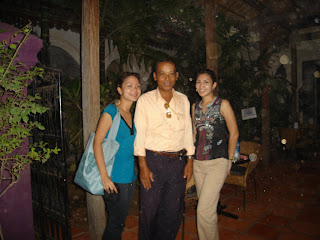
Our tour guide Mr. Sam

* * *

Angkor Wat’s architecture is said to represent the world.

The body of water surrounding it represents the oceans; its orientation, the sunrise and sunset that represent the earth’s rotation. The temple is about 900 years old and took about an estimated 32 years to build. (Mr. Sam emphasized that there are no written records for them to make sure how long it actually took to build the structure, and that this estimate is based on how long the king who commissioned it ruled.)

Although it took the whole duration of the king’s reign to build Angkor Wat, the temple is by no means finished. When the king died the construction ended with his reign, leaving the Eastern entrance in its half-completed state for all of eternity.

Most tourists, Mr. Sam said, would begin their tour of Angkor Wat through the Western Gate, so he took us first to the Eastern entrance to learn about how the temple was built. He said it was best to appreciate the basics before we actually proceeded inside to learn about the rest of the temple.

The Eastern Entrance


Without written accounts, the Eastern entrance actually provided valuable insights into how the Angkor Wat was built. Sandstone would be brought from down the river, with elephants carrying or dragging the stone slabs from there to the construction site. (Sorry, forgot the dimensions and weight, but pictures are provided below just to give you an idea.) Holes would then be drilled into the stones, where pieces of wood would then be driven, which were used as anchors for the ropes used to lift the slabs. It was only once the sandstones were in place that they were chiseled into size and carved with details, which meant any mistake in design would entail a repeat of the whole tedious process.


Unfinished work: sandstone slabs lying about

Workers did not finish boring holes into the stone. (Note the block's size.)


Mr. Sam explaining how the sandstone would fit into the puzzle on the floor.


It is quite interesting how the ancient Khmers did not use any type of cement to hold the structure together, at least according to our tour guide. (There is still some debate on this matter though, with some people saying vegetable paste was used to keep the stones in place.) Mr. Sam explained the no-cement theory by showing us the grooves carved into each piece of sandstone, alternately placed in the structure like puzzle pieces. The grooves serve a double purpose by letting the water that flows through the cracks stream through the structure, much like rain spouts, therefore preventing the stones from sliding. (Or some sort of explanation like that.)

Mr. Sam showing the grooves on the roof's stone


The most amazing thing about it is that after describing the amount of work that went into building the Angkor Wat, even the quality of the workmanship was so impeccable it was seamless. Mr. Sam was quick to point out to us that it was difficult to distinguish where one stone block ended and another one started; the alignment was so perfect, it was as if the whole structure was carved from just one massive stone.

Ah, just one of the many reasons we marvel at it.

Wednesday, December 06, 2006

Birthday Greetings

Som owie nek mein aryouk yrinyu (Cambodian) and Kblat chikan (Khmer) to our fellow camwhore in Cambodia, Nins!
Here she is in various candid shots (ruining Charlie's frame) during the trip:

At Banteay Srei/Srey


At Banteay Samre

At Angkor Wat

* * *
And finally, a not candid picture:

A *beaming* Nins with the Hindu god Vishnu (to whom Angkor Wat was dedicated)

Happy birthday Nins!